
Introduction
Artificial Intelligence (AI) is transforming the way businesses connect with customers, promote their products, and grow online. In today’s competitive digital world, traditional marketing strategies are no longer enough to achieve consistent results. Businesses need smarter, faster, and more personalized approaches to attract their target audience. This is where AI plays an important role.
AI enables marketers to analyze large amounts of data, understand customer behavior, create content, automate repetitive tasks, and improve advertising performance. From chatbots and personalized recommendations to AI-powered SEO and social media management, this technology is changing almost every aspect of digital marketing.
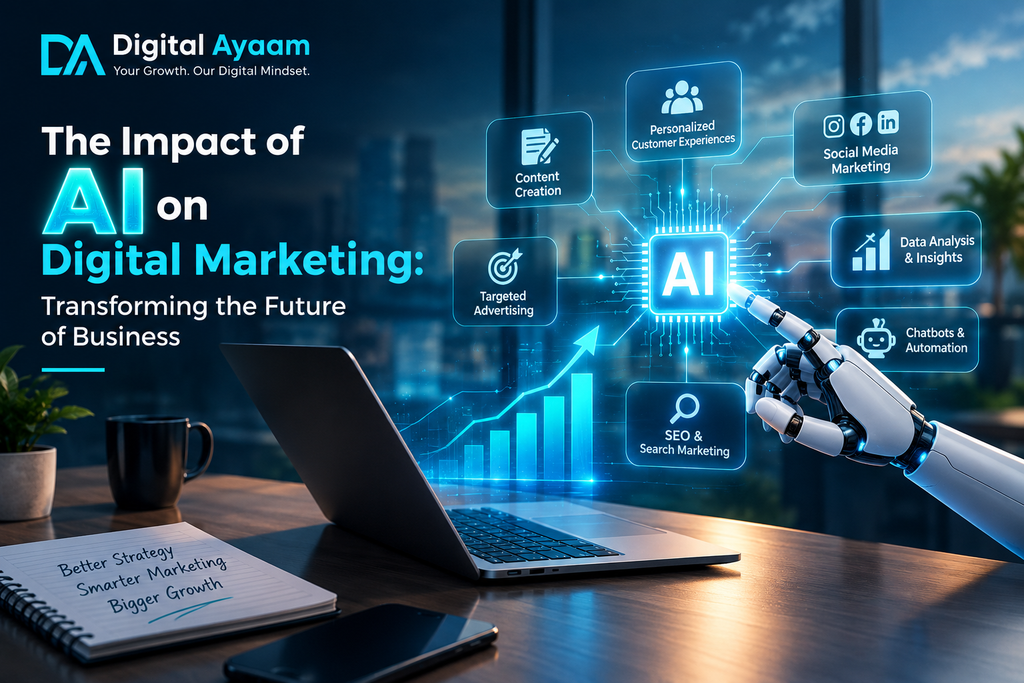
For businesses and digital marketing agencies like Digital Ayaam, AI offers new opportunities to build stronger brands, improve customer experiences, and achieve measurable growth.
1. What Is AI in Digital Marketing?
AI in digital marketing refers to the use of artificial intelligence technologies to plan, execute, analyze, and optimize marketing activities. These technologies can identify patterns in data, generate content, predict customer behavior, and support marketing decisions.
Some popular applications of AI in digital marketing include:
- AI-powered content creation tools.
- Chatbots and virtual assistants.
- Automated email marketing.
- Personalized product recommendations.
- Predictive analytics and customer insights.
- Search engine optimization (SEO).
- Automated advertising campaigns.
AI does not necessarily replace digital marketers. Instead, it helps them work more efficiently by handling repetitive tasks and providing insights that support better decisions.
2. AI Is Transforming Content Marketing
Content marketing is essential for building brand awareness, attracting potential customers, and developing trust. However, creating high-quality content consistently can be time-consuming.
AI tools can help marketers generate blog outlines, social media captions, email drafts, video scripts, product descriptions, and creative ideas. They can also assist with content research, proofreading, and adapting content for different platforms.
For example, a digital marketing agency can use AI to develop Instagram captions, plan a monthly content calendar, or prepare an initial draft of a blog.
However, AI-generated content should always be reviewed by humans. Marketers must check factual accuracy, originality, brand voice, and relevance to the target audience. Real experiences, expert knowledge, and creative thinking remain important for producing valuable content.
3. Personalized Customer Experiences
Modern customers expect brands to understand their interests and needs. AI helps businesses deliver more personalized experiences by analyzing customer interactions, browsing behavior, purchase history, and preferences.
For example, an e-commerce website can recommend products based on a customer’s previous purchases or browsing activity. An email campaign can display different offers to different customer segments.
Personalization can help businesses deliver more relevant messages, improve engagement, and increase the likelihood of conversions.
However, businesses should use customer information responsibly, follow applicable privacy regulations, and avoid collecting unnecessary personal data.
4. AI in Social Media Marketing
Social media platforms are important channels for building brand awareness and engaging with audiences. AI helps marketers improve social media planning and performance.
AI tools can assist with generating post ideas, analyzing engagement, identifying content trends, drafting captions, and organizing publishing schedules. Social listening tools can also help businesses understand customer opinions and monitor conversations about their brands.
For example, a brand can analyze which posts receive more engagement and use those insights to improve future content.
Despite these advantages, successful social media marketing still requires a human understanding of audience emotions, cultural trends, storytelling, and brand identity. AI should support the strategy rather than determine every creative decision.
5. AI in SEO and Search Engine Marketing
Search engine optimization helps businesses improve their visibility in search results. AI is making SEO research and optimization more efficient.
Marketers can use AI to brainstorm keywords, organize search intent, analyze competing content, identify content gaps, and develop article outlines. AI-powered analytics can also help identify patterns in website traffic and user behavior.
In paid advertising, AI-driven systems can assist with bidding, audience targeting, budget allocation, and creative optimization. Advertising platforms such as Google Ads use machine learning to help advertisers reach people who are more likely to take specific actions.
However, AI cannot guarantee higher rankings or successful advertising campaigns. Strong results still depend on useful content, relevant landing pages, accurate tracking, suitable targeting, and continuous testing.
6. Chatbots and Marketing Automation
Customer communication is another area where AI is creating significant change. AI-powered chatbots can answer frequently asked questions, provide product information, guide customers through websites, and help users find relevant services.
For example, a digital marketing agency can use a chatbot to explain its services, collect enquiry details, and guide potential clients toward a consultation.
Marketing automation also helps businesses send follow-up emails, segment audiences, and manage customer journeys with less manual effort.
These tools can improve response times and provide support outside normal business hours. Nevertheless, businesses should offer a way to contact a human representative when a question is complex or requires personal attention.
7. Benefits of AI in Digital Marketing
AI offers several important benefits for businesses and marketers.
Increased efficiency: AI can speed up research, drafting, reporting, and repetitive marketing activities.
Better data analysis: It can help identify patterns in campaign performance and customer behavior.
Improved personalization: Businesses can deliver more relevant content, recommendations, and offers.
Campaign optimization: AI-powered tools can help marketers test and refine advertising strategies.
Scalability: Small businesses and marketing agencies can manage more activities without increasing manual work at the same rate.
These benefits depend on choosing appropriate tools, maintaining good data quality, and measuring actual business outcomes.
8. Challenges and Risks of Using AI
Although AI offers many advantages, it also presents challenges. AI-generated information may be incorrect, outdated, biased, or misleading. Content created without human review can sound generic and fail to reflect a brand’s personality.
Privacy and data security are also important concerns. Businesses must handle customer information responsibly and understand the terms of the tools they use.
Another challenge is overdependence on automation. If every business publishes similar AI-generated content, brands may struggle to stand out.
The best approach is to combine AI’s speed and analytical capabilities with human creativity, critical thinking, ethical judgment, and industry knowledge.
9. The Future of AI in Digital Marketing
The future of digital marketing will likely involve greater use of AI-assisted research, predictive analytics, conversational experiences, and automated campaign optimization. Marketers may increasingly use AI agents to coordinate multiple tasks, while human professionals focus on strategy, creativity, relationships, and business decisions.
As these technologies develop, digital marketers will need to improve their skills in data analysis, prompt writing, performance measurement, content strategy, and responsible AI use.
Businesses that experiment carefully, evaluate results, and adapt to changing customer expectations will be better positioned to benefit from these developments.
Conclusion
Artificial Intelligence is reshaping digital marketing by making content creation, customer personalization, SEO, advertising, and automation more efficient. It helps businesses understand their audiences, improve marketing workflows, and make more informed decisions.
However, AI is not a complete replacement for human expertise. Accuracy, creativity, trust, and meaningful customer relationships remain essential to successful marketing.
The most effective strategy is to combine AI technology with human intelligence. For businesses looking to strengthen their online presence, adopting AI thoughtfully can create valuable opportunities for sustainable growth.
Digital Ayaam — Your Growth. Our Digital Mindset.